To the optimist, the glass is half full. To the pessimist, the glass is half empty. To the engineer, the glass is twice as big as it needs to be.

This is default featured post 2 title

Go to Blogger edit html and find these sentences.Now replace these sentences with your own descriptions.

This is default featured post 3 title

Go to Blogger edit html and find these sentences.Now replace these sentences with your own descriptions.

This is default featured post 4 title

Go to Blogger edit html and find these sentences.Now replace these sentences with your own descriptions.

This is default featured post 5 title

Go to Blogger edit html and find these sentences.Now replace these sentences with your own descriptions.

Showing posts with label Features. Show all posts

January 25, 2014

Montjuic Communications Tower, Barcelona Spain

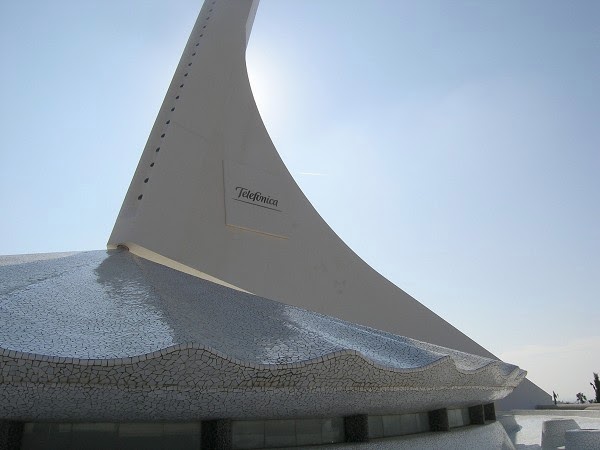
Calatrava's beautiful and original communications tower was built for Telefónica in the heart of the 1992 Olympic site, to carry coverage of the Games. Aside from its distinctive structural form, the tower is innovative in enclosing the circular platform of microwave dishes, replacing the normal clutter with a serene white arc. As a result the 130 meter structure becomes a welcome feature in the Olympic park.

Imagery abounds. The overall form of the tower is based on a Calatrava sketch of a kneeling figure making an offering. The base on which the figure 'kneels' is covered in broken glazed tiles in recognition of Gaudi (though with more restrained colors). The orientation of the tower means that the shadow of the central needle on the circular platform acts as a (rather impractical) sundial.

The twirly tower meets the ground very delicately at  
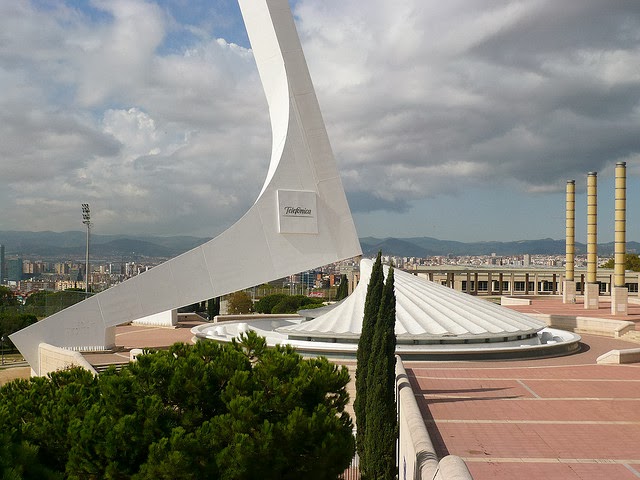
a pin-point, seeming to float in the air like a twisted paper clip. The base is covered with broken shards with Gaudí's technique of mosaic. Majestic fountains stand before the stair procession to the tower.


Construction Details:

Architects: Santiago Calatrava / Study Architecture: Santiago Calatrava Tower Construction: - Use: Torre Telefonica telecommunications company.

Technical Data:

Overall height: 136 m. built: 1992 Mounting: It was built as symbolic piece with the rest of the Olympic ring, in Montjuïc. Beside the Collserola communications tower of Norman Foster, make the communications system of the city of Barcelona and its metropolitan area.


Tower Design: 

Barcelone experienced an explosion of architecture and urban renewal on the occasion of the Olympic Games in 1992, and one such example is the telecommunications tower built Santiago Calatrava, Olympic ring in full for the event. This tower was commissioned by the national telecommunications company by then, Telefonica SA of Spain to give everyone coverage of the Olympic Games in Barcelona. Montjuïc tower - original-name popularly known as Torre Calatrava, presents an innovative and striking design with traditional telecommunication towers. Telefónica broke its traditional model, often a smaller replica of the famous Lollipop height of the capital Madrid to participate in the need that Spain had in 1992, to show everyone a modern and innovative country. Madrid (European cultural capital), Sevilla (Expo 92) and Barcelona (92 Olympics) were the perfect showcase to present to the world a country that had been able to leave a dictatorship into a democracy and capacity to modernize in a short period of time. A country able to meet the challenges of the future, able to organize two major international events at the same time and be attractive to tourists and investors. Regarding originality, apart from its distinctive structural form, the tower is innovative in including the circular platform dishes of data transmission (transmitters), replacing the traditional body of antennas by an arc with a striking layout. This set of elements make the structure of 130 meters to become more than a tower .. a nice sculpture in the Olympic ring. The shape of the tower is based on a Calatrava sketch of a figure of an athlete of ancient Greece, to kneel on when you pick up the medal, as the winner of an Olympic event. The base of the tower is covered in broken glazed tiles in recognition of Gaudi and his famous technique of "Trencadís". The orientation of the tower gets to become a giant sundial, marking the hours on the square in Europe.

Details of Structure:

It was not the only telecom tower in town for the 1992 Collserola Tower British Norman Foster was also raised in the other mountain city, Tibidabo. This second tower has a larger television, and radio coverage of telecommunications signals to the entire city of Barcelona and its metropolitan region function consists of more than 4.5 million inhabitants. coverage of 92 Olympics: Images of the Barcelona Olympics that saw much of the world's inhabitants were made ​​possible by the intense audiovisual coverage of the event, which provided Telefónica modern means of transmission. ISDN was the basic telecommunications infrastructure used in 1992. The investment made ​​by the company, only to meet the needs of the Games, was 92,000 million pesetas in four years. During the Games originated in Barcelona two million phone calls. At the end of the competition, Barcelona had built a telecommunications infrastructure up to the most advanced in Europe.

General Information

Structural Type: Vertical cantilever structure 
Function / usage: Communications tower 
Built: 1989 - 1992
Status: in use

Geographic Information & Related Structures

Location: Barcelona, Barcelona, Catalonia, Spain, Europe
Near Sant Jordi Sports Palace (1990)

Technical Information:

Height: 136 mts
Material: Steel.  


Sources: [...] [...] [...]

January 14, 2014

ThyssenKrupp combines plant technology capabilities

Uhde, Polysius and Fordertechnik combined under the roof of ThyssenKrupp Industrial Solutions...............................


As part of its strategic way forward, ThyssenKrupp is strengthening its plant technology business as a major growth area for the Group. To better exploit global market opportunities the previously separate plant technology companies of the Group are being combined under the roof of ThyssenKrupp Industrial Solutions. The merger of the German companies of ThyssenKrupp Uhde and ThyssenKrupp Resource Technologies (created from ThyssenKrupp Polysius and ThyssenKrupp Fordertechnik) with ThyssenKrupp Industrial Solutions is now an important milestone in the integration process.
Dr Heinrich Hiesinger, CEO, ThyssenKrupp, said, “The integration and regionalisation of our plant technology business is an important element of our transition into a diversified industrial group. This growth area offers great potential, which we can exploit optimally with ThyssenKrupp Industrial Solutions as a global, integrated engineering and construction company. Our aim is to grow faster than the market.”
Dr Hans Christoph Atzpodien, CEO, ThyssenKrupp Industrial Solutions, added, “Combining the strengths of our three successful long-standing plant technology companies and acting as one company on the global stage in the future will increase our impact particularly in the growth regions and enable us to carry out projects worldwide on a whole new scale. We plan to increase ThyssenKrupp Industrial Solutions' sales by on average more than five percent per year in the coming years.”
With over Euro 5.6 billion in sales in fiscal year 2012/2013 and around 19,000 employees, ThyssenKrupp Industrial Solutions ranks among the world's leading plant technology companies and holds top-three positions in key market segments. The company offers its customers engineering, procurement and construction (EPC) as well as associated services from a single source and has decades of experience gained in building more than 5,000 plants. With highly efficient chemical, refinery, cement and other industrial plants as well as equipment for open-pit mining, ore processing and port handling, ThyssenKrupp Industrial Solutions enables its customers to meet increasing worldwide demand for 'more' energy, raw materials and capital goods in a 'better' resource-friendly way.
Under the roof of ThyssenKrupp Industrial Solutions, plant technology operations worldwide will be managed by the two business units Process Technologies and Resource Technologies. Process Technologies is focused on engineering, procurement and construction for chemical, refinery and other industrial plants, while Process Technologies offers a comprehensive product portfolio and a wide sales and service network to customers in the mining, cement, mineral processing and materials handling industries. The traditional brands Uhde and Polysius will be retained as product names. Besides Essen, the future headquarters of ThyssenKrupp Industrial Solutions, the company will have 40 branch offices in 25 countries around the world.
To support the global exchange of knowledge and engineering services and present a single face to the customer, new regional organisations are being set up. These will make it possible to manage projects in the regions with a stronger focus on local requirements. As the integration process continues the respective foreign subsidiaries of ThyssenKrupp Uhde and ThyssenKrupp Resource Technologies will also be gradually combined into one company per country under the name ThyssenKrupp Industrial Solutions. This will create a much larger and more efficient organisation worldwide.
ThyssenKrupp Industrial Solutions is one of six business areas of the ThyssenKrupp Group. Alongside Process Technologies and Resource Technologies it also includes the companies ThyssenKrupp Marine Systems, offering engineering services for submarine and shipbuilding, and ThyssenKrupp System Engineering, with production equipment for the automotive and aerospace industries.

Twitter Facebook Favorites More